Trending

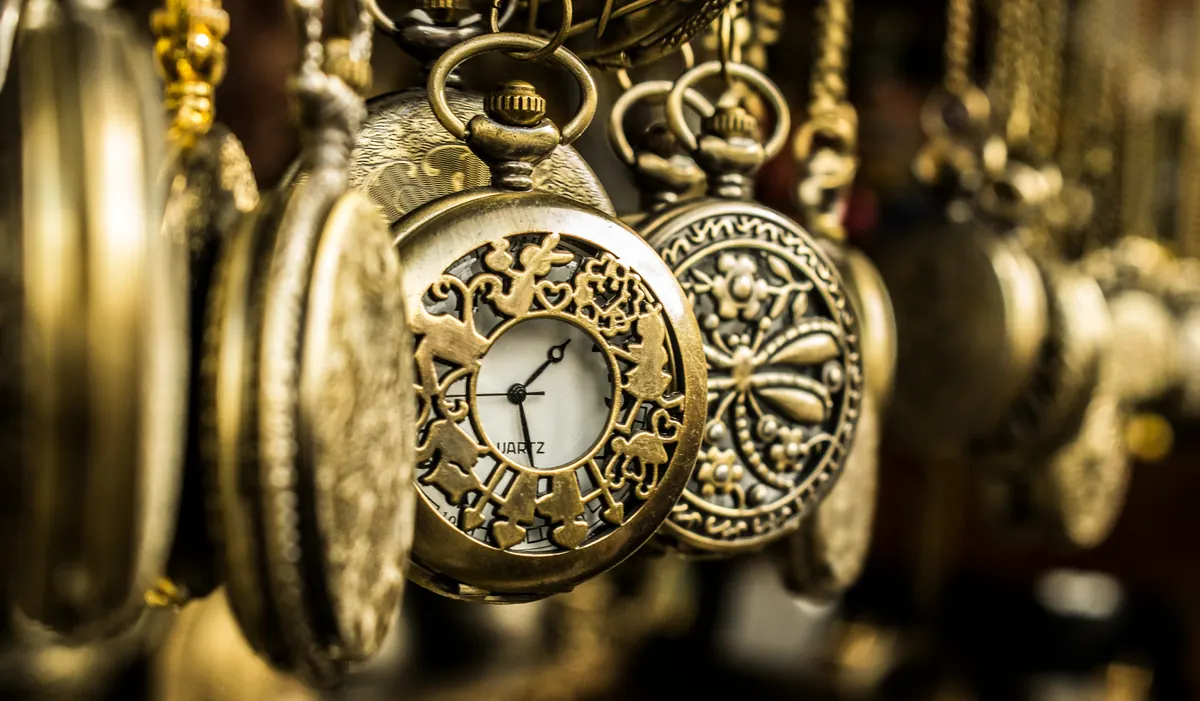
A vintage pocket watch rarely gives up its story all at once. The case may carry a town, a date letter, and a maker’s mark; the dial may speak in numerals and hand shapes; the movement may hide its grade behind a dust cover. Identification is less about finding one magic stamp than learning to read three or four small clues together. Start with what is visible, record it carefully, and only then reach for reference books or online archives. The watch will reward a slow, methodical look.
The case is the safest place to begin because most of its evidence sits on the outside. Turn the watch over, tilt it under a lamp, and look for stamped marks near the bow, on the inner cover, or along the edge of the back. Use a loupe if you have one. Fingernails and good raking light will reveal more than a flat overhead lamp.
On British silver and gold cases, a full hallmark generally combines a maker’s mark, an assay office mark, a standard mark, and a date letter. The date letter means little on its own: the same letter repeats in different cycles and at different assay offices. Look at the whole set, then match it to the right office and period. Continental cases often carry a purity stamp—800, 835, 900, or 925—plus a maker’s poinçon. American cases may name the case maker and state whether the metal is solid gold, gold-filled, or rolled gold. None of these marks tells you the movement’s quality by itself, but they narrow the field.
Open the back gently and note whether the case is a hunter, with a hinged front cover, or an open-face watch that exposes the dial. Check the hinge, bow, crown, crystal, and covers. A case that opens smoothly and closes square is a good sign; a loose hinge or an oval bow is not fatal, but it affects condition. Replacement crowns and mismatched covers are common. Extra screw marks inside the back cover can suggest that a different movement has been fitted. Record the case diameter, metal, marks, engraving, and any monogram. Do not polish the marks; a soft cloth and raking light are enough.
Dials are easy to read and easy to misread. A handsome face can hide a replacement, and a tired face can still be original. Look at the dial as a whole, then examine the details one by one.
Enamel dials were common on earlier watches, and their glassy surface can develop hairline cracks with age. A hairline is usually stable; a chip near the winding aperture or the subsidiary seconds bit is more serious because it can spread. Metal dials became more common later and may be painted, printed, or finished with applied numerals. Look for bubbling, touched-in paint, or a surface that does not match the watch’s apparent age.
Roman numerals, Arabic numerals, railroad-style dials, and subsidiary seconds all point to different traditions and uses. The hands should look at home on the dial: spade hands, Breguet hands, moon hands, and simple batons all belong to particular styles. A mismatched hand is not always wrong—repairs happened—but it is a clue. Check that the hands align correctly at the hour and that the seconds hand sits squarely on its bit.
A name on the dial may be the maker, the retailer, or an exporter. That distinction matters. A retailer’s name is not proof that the retailer made the watch, and a blank dial is not proof of low quality. Under a loupe, original enamel lettering sits in the glaze; overpainting can look raised, too crisp, or slightly off in color. A signature that is far brighter than the surrounding enamel deserves a second look.
Once the back is open, resist the urge to diagnose everything at once. Start with the layout, then the finish, then the numbers.
Full-plate, three-quarter-plate, and bridge movements have different silhouettes, and those shapes help place a watch in a broad tradition. Note whether it is key-wind or stem-wind, and whether it sets from the back or the front. The lever escapement is common in later pocket watches; cylinder and verge escapements point to older or more modest pieces. Jewel count can help narrow a grade, but verify it under a loupe rather than trusting a seller’s description.
Write down every number you can see: movement serial, case serial, patent numbers, import marks, and any signature on the barrel bridge or plate. Case and movement numbers often differ because case making was a separate trade. Matching numbers are pleasant, but they are not the only measure of originality. A movement signature may belong to the maker, a wholesaler, or an exporter, so record it exactly as stamped.
Look at the screw slots, the hairspring, the balance, and the regulator. Chewed screw heads suggest repeated or careless repair. Rust, green verdigris, and a hairspring that is bent or tangled are more serious than a dusty plate. A watch that ticks is not automatically healthy; a dry or stiff movement can run just long enough to mislead. Do not overwind it or force the crown.
Use the same order every time. It keeps you from jumping to a conclusion before you have the evidence.
Research goes badly when it starts with a guess. Build a small file first: case metal and marks, dial style, hand type, movement layout, serial numbers, condition notes, and clear photographs. Then compare like with like—same case style, same dial layout, same movement shape. A date letter needs the right assay office and cycle; a maker’s mark needs the right country. A single mark pulled out of context can send you in the wrong direction.
Write down what you see, not what you hope to see.
Beware of “marriages,” where a movement and case from different watches have been paired later. A marriage can still be a useful watch, but it is not original, and it should be described as such. If a seller cannot show the inside of the case or the movement, treat the listing as incomplete. For valuable pieces, ask a qualified watchmaker or appraiser to confirm the details before money changes hands.
Identification is a habit, not a single lookup. Read the case marks, study the dial, record the movement clues, and keep your notes with the watch. If you are buying, price condition and originality rather than romance. If the watch is inherited, keep it dry, avoid polishing the marks, and have it serviced by a qualified watchmaker before regular use. For insurance or estate questions, use a qualified appraiser who knows vintage watches.
Photo: abdullah . / Pexels