Trending

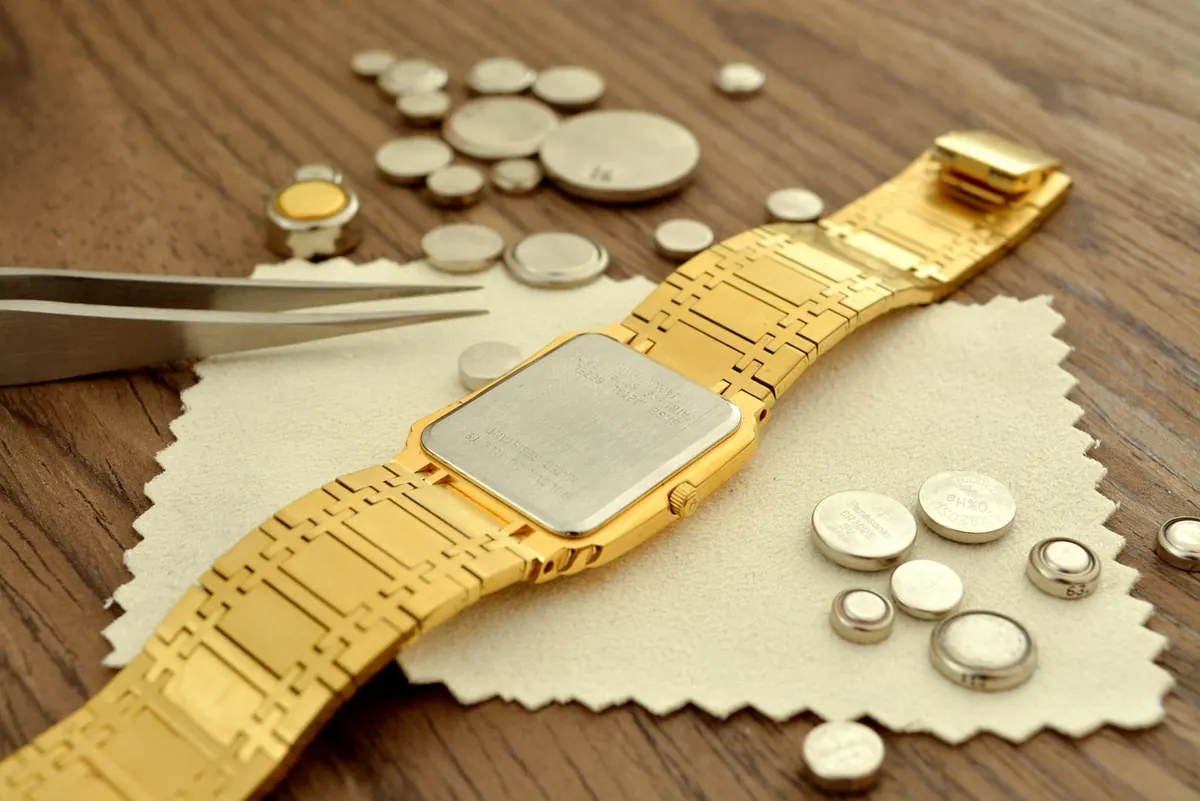
Two collectors can look at the same 1960s three-hander and see completely different objects. One sees a dial, a case and a price. The other notices a worn crown, a replacement crystal and an amplitude figure that hints the mainspring is tired. Vocabulary is what separates them — not as a party trick, but because the words are the questions you need to ask before money changes hands. The thirty terms below turn up constantly in listings, service invoices and auction catalogues. Learn them and you can read a watch description the way a mechanic reads a service record.
Most movement vocabulary describes how stored energy becomes a steady tick.
Escapement — the mechanism between the wheel train and the balance that lets the train advance one tooth at a time. Each release pushes the balance, and that push is the tick you hear. Lever escapements are everywhere; detent and cylinder designs appear in older pieces and change what you should expect from servicing.
Arbor — the shaft a wheel or pinion turns on. A bent arbor makes a hand wobble; worn pivots at the ends of an arbor show up as low amplitude. When a watchmaker says pivots have been burnished, they mean those ends were polished so they sit cleanly in the jewels.
Wheel train — the run of gears carrying power from the barrel to the escapement. Its ratios decide how fast the hands turn, which is why a swapped wheel can leave a watch keeping time and still showing the wrong date.
Barrel — the drum that houses the mainspring and drives the train as it unwinds.
Mainspring — the coiled ribbon of steel alloy inside the barrel. A tired mainspring is one of the most common reasons a vintage watch loses amplitude and stops overnight.
Balance wheel — the oscillating weight at the heart of the movement. Together with the hairspring it forms the oscillator, the part that actually keeps time.
Hairspring — the fine spiral that returns the balance. Its working length and stiffness set the rate, so a magnetised or dirty spring can send a watch running minutes fast.
Jewels — synthetic ruby bearings that reduce friction where pivots turn. The count is not a score: a well-made 15-jewel watch will outlast a careless 25-jewel one, and jewels in non-load-bearing spots exist mostly for marketing.
Rate — how fast or slow a watch runs, in seconds per day. Judge it over several days in consistent conditions, not from a single reading taken at a kitchen table.
Regulation — the adjustment that corrects rate: a regulator arm on older pieces, mass screws on a free-sprung balance, with a timing machine as referee.
Beat error — the gap between the tick and the tock, measured in milliseconds. A watch can show a perfect average rate and still be badly out of beat; close to zero is healthy.
Amplitude — how far the balance swings, in degrees. Healthy figures depend on the movement: many modern watches sit somewhere around 270–315 degrees, while older pieces often run lower. A sudden drop usually points to lubrication or wear.
Isochronism — the ability to hold the same rate whether fully wound or nearly run down, flat on a table or worn on the wrist.
Positional variation — the spread in rate between positions: dial up, crown down, crown left. A few seconds is normal; twenty is a reason to ask questions.
Hacking seconds — a seconds hand that stops when the crown is pulled, so you can set the time against a reference signal exactly.
Complication — any function beyond hours, minutes and seconds. A date qualifies; so does a minute repeater.
Chronograph — a stopwatch built into the watch, started and stopped by pushers. The word has nothing to do with chronometer, and mixing them up in a shop is the quickest way to be quoted a higher price.
Chronometer — a movement certified for accuracy by an official testing body; in Switzerland that is usually COSC. It is a certification, not a style of watch.
GMT — a second time zone shown by an extra 24-hour hand. On a true GMT the hour hand jumps independently while the 24-hour hand stays put; on a caller version it is the 24-hour hand you set.
Perpetual calendar — a calendar that knows short months and leap years. An annual calendar needs one correction a year, in February, while a simple complete calendar needs adjusting at the end of every short month.
Power reserve — the running time from a full wind, and sometimes a dial indicator for it. Compare the real figure with the specification: a watch rated at 42 hours that stops at 30 needs attention.
Lug — the horn-shaped projections where a strap or bracelet attaches. Lug width, measured in millimetres between them, decides which straps fit; 20 mm is common, 19 mm narrows your choices considerably.
Bezel — the ring around the crystal. On a dive watch it rotates, and whether it clicks firmly and lines up at twelve matters. A replaced bezel insert is easy to spot under a loupe and can cool collector interest fast.
Crown — the knob for winding and setting. Screw-down crowns seal better. A signed crown suggests originality; an unsigned one points to replacement, which is fine on a daily wearer and costly on a collectible.
Crystal — the cover over the dial. Acrylic scratches and polishes out, mineral glass sits in the middle, sapphire resists almost everything but can chip. A replacement crystal is routine; a cracked one means stopping to check for moisture.
Chapter ring — the ring inside the case edge carrying the minute track or 24-hour numerals. Printing that sits out of alignment is a clue a dial has been refinished.
Sub-dial — a small dial set into the main one, for running seconds, a date or a chronograph register. Check that the printing lines up and that every sub-dial completes its full range.
Patina — honest ageing: lume gone cream, case edges softened by decades of wear. It is not a synonym for damage. The word also sells water-stained dials and touched-up cases, so ask for a straight-on photograph taken in daylight.
Frankenwatch — a watch assembled from parts of several others, sometimes called a marriage. Vintage pieces often carry a service replacement somewhere; the problem is when dial, case, movement and hands come from different watches and nobody says so.
Overhaul — full disassembly, cleaning, fresh lubrication, reassembly and regulation. “Serviced” can mean that, or a squirt of oil, so ask for the date, the watchmaker and the invoice.
Jargon earns its keep only when it changes a decision. Before you buy, use these words to get facts rather than adjectives. A seller who answers a question about beat error with a number is worth more of your time than one who answers with a paragraph about rarity.
For anything expensive, have a watchmaker inspect the movement before money changes hands; a bench fee is far cheaper than a wrong call on a vintage piece. And if a seller cannot name the parts of the watch they are selling, that is information too — often the most useful you will get.
Photo: 11754907 / Pixabay